
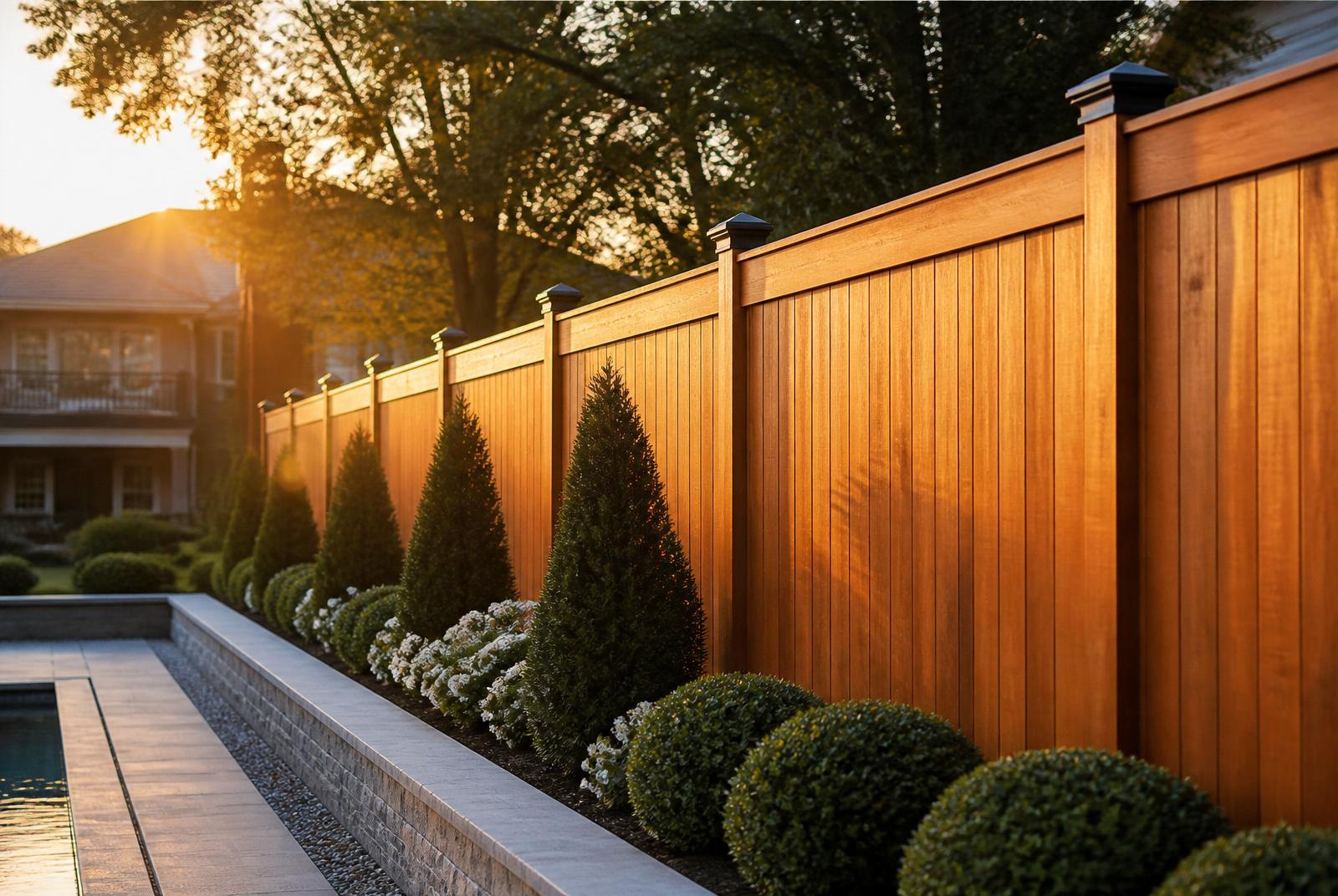
The Best Privacy Fence Options for Long Island Backyards
Lots on Long Island are close together. Whether you back onto a neighbor's deck, a busy road, or a shared driveway, privacy is the single most common reason homeowners here call a fence company. Here are the options that actually work, and the tradeoffs of each.
Vinyl privacy panel
The default choice, and for good reason. Tongue-and-groove vinyl panels form a solid wall with no gaps, in heights up to six feet. No maintenance beyond washing, no rot, no staining, and it looks the same in year fifteen as it did in year one.
The knock on vinyl is that a long unbroken run of solid white can feel like a wall. There are easy fixes. Accent tops with lattice or spaced picket sections break up the mass and let light through. Wood-grain textures and tan, khaki, or grey colors read softer than bright white. Stepping the height down as the run moves away from the patio also helps.
Vinyl privacy is also completely solid, which means it catches wind. On exposed properties, post depth and concrete matter enormously. This is not the place to hire the cheapest bid.
Board-on-board cedar
The best-looking privacy fence you can build. Boards are alternated on opposite sides of the rails with an overlap, so there is no line of sight through it, but air still moves and the fence has depth and shadow rather than reading as a flat panel.
Board-on-board also solves the shrinkage problem that plagues standard wood fences. As boards dry and shrink, a butted fence develops gaps you can see through. With the overlap, shrinkage never opens a sight line.
Cedar costs more than pressure-treated and needs sealing every few years. In exchange you get a fence with real character that can be stained any color you want later.
Shadowbox
Similar construction to board-on-board but with a wider gap, so boards alternate with a deliberate space between them. You get near-total privacy when viewed straight on and partial visibility at an angle. It looks identical from both sides, which makes it the diplomatic choice for a shared property line, and it passes wind better than a solid panel.
Stockade
The budget privacy option. Pointed pickets butted tight, usually pressure-treated pine. It does the job and costs the least. Expect gaps to open as the wood dries, and expect a shorter service life than cedar. Fine for a back property line, less appealing along a patio you look at every day.
Horizontal slat
The modern look, and it has gotten very popular on Long Island in the last few years. Wide horizontal boards with a narrow reveal between them, usually in cedar. It suits contemporary homes beautifully.
Two cautions. Horizontal boards are more prone to sagging over long spans, so post spacing needs to be tighter and lumber selection matters more. And horizontal members on the outside face are climbable, which disqualifies this style as a pool barrier in most cases.
Aluminum with landscaping
Sometimes the right answer is not a solid fence. In waterfront and view properties, homeowners often choose ornamental aluminum for the boundary and get privacy from dense plantings behind it. You keep the view and the breeze, you satisfy pool code, and the screening fills in over a few seasons.
Composite
Composite privacy fencing is worth mentioning. It gives a wood look with vinyl-level maintenance and is very rigid. It is the most expensive option per foot, which keeps it a niche choice, but for a short high-visibility run it can be worth it.
Getting real privacy, not just height
A few things matter more than people expect:
- Close the gap at the bottom. A four-inch gap under a fence undoes a lot of the privacy, especially on a patio at seated eye level.
- Watch the grade. On sloped yards, stepping panels leaves triangular gaps unless the bottoms are custom cut.
- Think about elevation. If your neighbor's deck is raised, a six-foot fence at grade may not block anything. Sometimes the answer is a pergola with a privacy wall at the patio instead.
- Check your height limit first. Rear yards on Long Island are commonly capped around six feet, and lattice tops usually count toward the total.
We will walk your yard, look at the actual sight lines from where you sit, and design around them. Call Magistrale Fence & Railing at (631) 784-3258 for a free estimate.